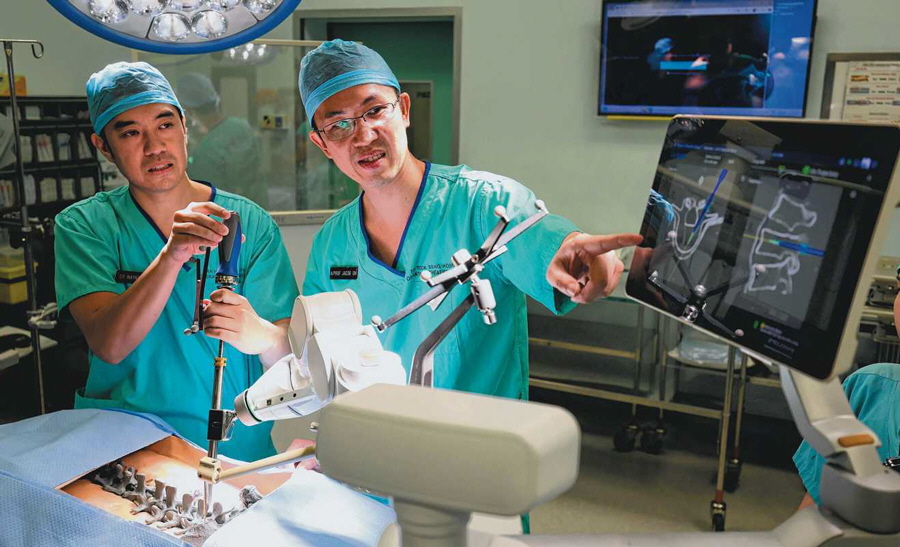
 Dr Wayne Yap (far left), a consultant at Tan Tock Seng Hospital’s orthopaedic surgery department, and Adjunct Associate Professor Jacob Oh, head of spine surgery and a senior consultant in the department, demonstrating how an AI tool developed by medtech company Medtronic assists the planning and execution of complex spinal surgery. PHOTOS: LIANHE ZAOBAO
It aids pre-surgery planning, provides greater accuracy in implantation of screws and rods
The Straits Times (8 December 2025)
Complex spinal surgery at Tan Tock Seng Hospital (TTSH) has been made faster, safer and more precise with the use of artificial intelligence (AI).
As Singapore’s population ages rapidly, more seniors are likely to suffer from spinal conditions, including complex deformities such as degenerative scoliosis with nerve compression.
Hospitals here have been riding the wave of adopting AI in healthcare for better outcomes, such as analysing a cardiac scan for a faster diagnosis of coronary artery disease, and analysing medical lab reports with a comprehensible summary and explanation of the results.
Similarly, in TTSH, its department of orthopaedic surgery has successfully performed more than 250 AI-assisted spinal surgical operations since 2021. These were mostly complex surgical operations for elderly patients.
Complex spinal surgery used to be done with surgeons deciding on surgical details only in the operating theatre, such as the exact positions in the spine and the ideal angles to implant the screws and rods, as well as the contour of the rods.
Rods and screws are implanted to hold the spine at its corrected position and keep the spine aligned properly.
This process relied heavily on the surgeon’s experience and could result in variable accuracy rates, given that the patient would be lying flat and presenting the spine differently compared with when standing straight, said
Dr Wayne Yap, a consultant at TTSH’s
orthopaedic surgery department.
With AI aiding pre-surgery planning and providing greater accuracy in the implantation of the screws and rods, TTSH surgeons can now concentrate on aspects of the surgery that require their professional expertise and skills.
An example is a surgeon adjusting the angle of implantation for patients with osteoporosis, as their spinal bones would have softened, said Dr Yap.
The AI tool developed in Europe by medtech company Medtronic allows for auto-analysis of the patient’s X-ray to assess the state of the spine, as well as predictive modelling of the potential outcomes of the surgery, including if the spine can be straightened to a normal and functioning state.
This pre-surgical planning can now be completed outside the operating theatre.
In addition, "there is no more guesswork" with the AI tool, which allows for visualisation and simulation. This allows surgeons to determine the optimal positions for implants and customise the size and bends of each rod used to correct the spine, said
Adjunct Associate Professor Jacob Oh, head of spine surgery and a senior consultant at TTSH’s orthopaedic surgery department. With the deployment of this AI tool, patients who underwent complex surgery saw a reduction of their hospitalisation by up to 50 per cent, from an average of about seven to 14 days post-surgery, to about three to six days, said Dr Yap.
The surgery time saw a decrease of up to 20 per cent, as the planning work could be completed ahead of the surgery.
The use of the AI-assisted robotic arm helped to navigate and ensure the precise insertion of the implants. This also reduced the surgical time needed and the likelihood of major complications due to damage to other nerves or organs near the surgery site, which could potentially lead to paralysis or even death.
Of all TTSH patients who had AI assisted spinal surgery, none died or was paralysed.
Prof Oh said none of the patients had to undergo revision surgery to tighten any loose or misaligned screws, or had to be admitted to the intensive care unit after surgery. The use of advanced technologies comes at a price, for now. Patients who benefited from AIassisted robotic spinal surgery at TTSH received, on average, a 5 per cent to 10 per cent higher pre-subsidy bill, mainly due to the costlier custom-made rods to be implanted.
The rods used in traditional spinal surgery would have cost around $1,000 each, but the custom- made rods flown in from France cost 50 per cent more.
Nevertheless, the slightly higher price tag for such AI-assisted surgery did not turn patients away.
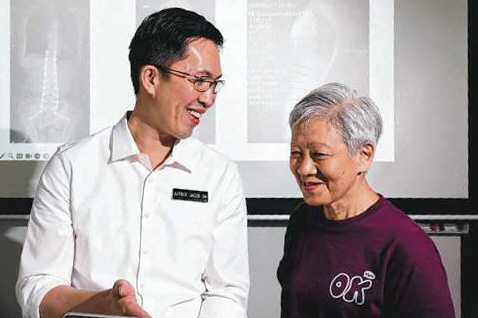
Madam Jenny Ee, who experienced debilitating pain that affected her quality of life, underwent open spinal surgery in July 2024 that lasted eight hours and was performed by Prof Oh. She can now brisk-walk a few kilometres each day.
Madam Jenny Ee, 74, used to be an avid jogger and visited the gym five times a week.
When she first experienced pain several years ago, which went from her lower back down to her left calf, she depended on oral painkillers.
Soon, the painkillers did not have much effect, and spinal injections of steroids could give her only one to two pain-free days.
It came to a point when she could barely walk for 10 minutes without resting. When she suddenly experienced excruciating pain while she was on the gym’s treadmill, she finally considered surgery.
She underwent open spinal surgery in July 2024 that lasted eight hours and was performed by Prof Oh. Twenty screws were implanted into her spine to fix the scoliosis.
Post-surgery, she spent two days in a high dependency ward and five days in a general ward before transferring to the TTSH Integrated Care Hub for three weeks to complete her inpatient physiotherapy.
Madam Ee can now brisk-walk a few kilometres each day, and has travelled to Taiwan and Malaysia. "From the debilitating pain, which resulted in me not having a good quality of life and a complete standstill for all my normal activities, it was a huge relief that just one day after the surgery, I no longer feel the same pain down the nerve," she said.
Before her surgery, she received an estimate of $70,000 to $80,000 for her total bill, with the consumables – the screws and rods – costing more than $30,000.
She paid about $10,000 after receiving government subsidies.
"As I wanted my life back, this was worth it," said Madam Ee.