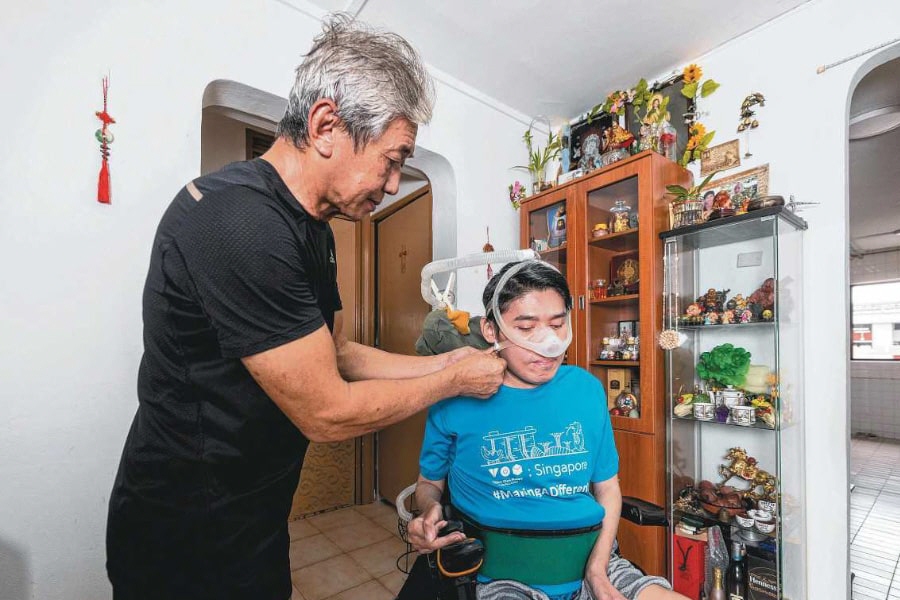
 For the past five years, Mr Steven Eng has been tending to the daily needs of his son William, who has muscular dystrophy. These include putting on a ventilator to help with his breathing. PHOTO: LIANHE ZAOBAO
The Straits Times (15 June 2025)
Childhood falls were an ordeal for
Mr William Eng.
Unlike other children, he could
not brush off a routine tumble.
While he remembers running in
primary school, he tiptoed as he
walked. Unbeknown to him, his
unusual gait was a symptom of
muscular dystrophy, a condition in
which muscles weaken over time.
Mr Eng, now 37, recalls: “I fell
easily and frequently. I wasn’t
afraid of falling down, but getting
back up was tiring. Initially, I could
get up on my own. But by secondary
school, my friends had to pull
me up from behind.”
He found out, through medical
checks ahead of registering for
national service, about his muscular
dystrophy at the age of 15.
Before that, he and his family had
cycled through unsuccessful attempts
at managing his symptoms,
including acupuncture; making him
consume brews with ingredients
from traditional Chinese medicine
like seahorse and frog legs; and sporadic
visits to the hospital.
Mr Eng says they did not know
they had to seek treatment in any
regular way. “We didn’t know
where to go.”
The eldest of four children, he
lives with his 59-year-old father
Steven Eng, who is his full-time
caregiver; his stepmother, a 56-
year-old cashier; and an uncle, 58,
who works part-time as a cleaner.
His younger brother and sisters,
aged between 25 and 36, do not
live with them.
From Mr William Eng’s teenage
years, his dad has been a bulwark
of support as their family grappled
with his condition.
He was about to repeat Secondary
3 because he did not take his
examinations for that grade the
year before. But he could not walk
by then, and dropped out of school.
Thus began a period of social isolation
that lasted around 14 years.
Although he soon acquired a
manual wheelchair through a
family friend, lifts would not be
installed at his family’s HDB block
in Tampines for several years.
On outings, his father would
carry him down the four flights of
steps from their three-room flat on
the third floor; seat him at the
coffee shop downstairs; and walk
to the main road to hail a taxi for
them, retracing that route upon
their return.
During this time, Mr William Eng
says he had “no peers”, save for one
secondary school friend who
visited him faithfully. His late
paternal grandmother, who used to
live in their household, was his
main carer for many years.
When his siblings grew older, they
would leave him food and water on
the table before they left for the day,
bringing him a dabao (takeaway)
meal when they got home.
Mr Steven Eng was working as a
contractor, specialising in signage
painting and facilities maintenance.
For close to 20 years, he
woke at 5.30am for work, returning
in the evening and spending
limited time with his disabled son.
For a year in the 1990s, he worked
in construction by day and held a
night job making soya bean milk at
a factory. Money was tight and he
slept about three hours a day.
When Mr William Eng was 29, he
came into contact with Muscular
Dystrophy Association (Singapore)
and spent most days of the
week at its Bishan location.
Equipped by then with a motorised
wheelchair which afforded
him more mobility and independence,
he filled his days with activities
such as therapy, art and craft,
and sports like powerchair football,
in which players use specialised
electric wheelchairs to play a
modified form of the sport.
He also spent several years
designing greeting cards and labels
for work projects gained through
the association.
But a health crisis struck on
Christmas Eve 2019, further weakening
him and prompting his father to
give up his career to care for him.
Mr William Eng was rushed to
hospital with high fever, a hacking
cough, pneumonia and a congested
lung.
During his 2½-month stay at Tan
Tock Seng Hospital, which included
about a month in intensive care, he
underwent intubation, whereby a
breathing tube is inserted; and subsequently
a tracheotomy, which
creates an opening through the
neck directly into the trachea or
windpipe, to provide an airway and
remove secretions from the lungs.
Mr Steven Eng sprang into
action, taking leave from work to
alternate 12-hour shifts at his son’s
hospital bedside with other family
members.
When Mr William Eng could not
speak for a few weeks, his father,
who cannot write in Chinese or
English, used a board with letters
and numbers to decipher what he
needed. The younger Eng would
nod or train his eye at one letter
after another, forming words like
“pain” for his father to write on
paper, indicating to hospital staff
what help was needed.
The decision to care for his son
full time was easy for the senior
Eng. “I told the hospital, please let
me take care of my son. I can provide
one-on-one, 24-hour care.
Rather than having a helper or one
of his siblings help out, I might as
well do it. I am old (and can give up
my work),” he says in Mandarin.
He quit work on New Year’s Day
in 2020.
For the past five years, Mr Eng
has been helping his son with daily
activities such as going to the bathroom,
showering and clothing him,
and giving him medicine. He also
puts on a ventilator for the younger
man, who uses this machine that
helps him breathe when he sleeps
at night, and for a few hours in the
afternoon.
He helps his son use a cough
assist machine, which clears his
airways and supports his breathing
by removing phlegm from his
lungs.
Mr Eng works out for an hour
daily, stretching and using dumbbells,
to keep up his strength so he
continues to be able to carry his
son when necessary.
The pair, who enjoy watching
movies together, attest to their
close relationship.
Mr Steven Eng says: “We are
friends, we speak directly to each
other.” He adds: “It’s not tiring caring
for my own child.”
Mr William Eng demurs. “My
father toils the most. He has sacrificed
a lot. Especially in Asian
society, people might ask, why
aren’t you working? It’s rare to find
a daddy caregiver.”
“I call him Penguin Daddy,” he
says, referring to how the male
emperor penguin incubates the
egg while the female goes away to
hunt at sea.