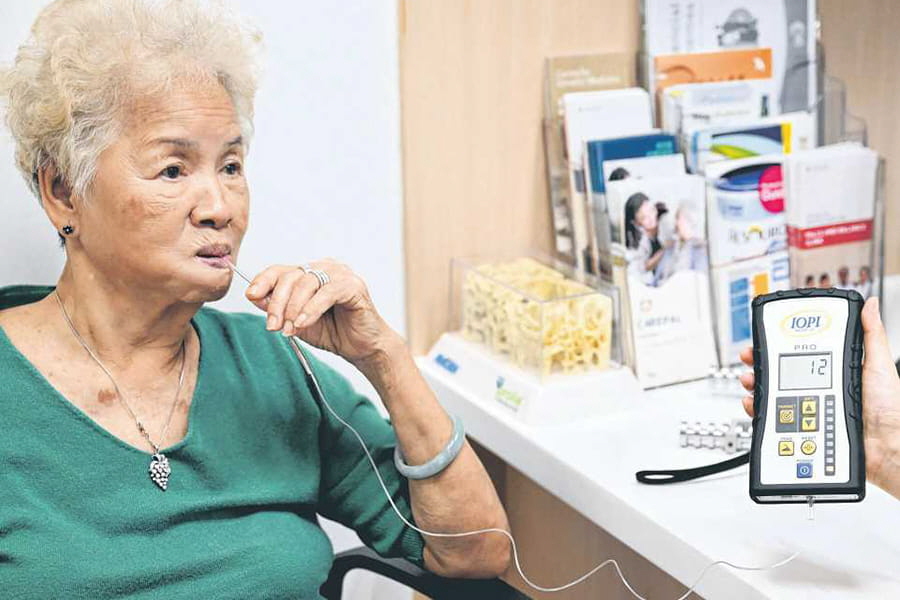
 Madam Tan Ah Sang measuring her tongue and lip strength with an oral performance instrument at Tan Tock Seng Hospital. Oral frailty serves as an early predictor of malnutrition risk, sarcopenia and physical frailty. ST PHOTO: NG SOR LUAN
Sarcopenia set to rise with ageing populace; prompt treatment can reverse the condition
The Straits Times (23 January 2026)
Madam Tan Ah Sang, 82, who has multiple health conditions including
Parkinson’s disease and
diabetes, was referred to the new clinic for muscle health at Tan Tock Seng Hospital (TTSH) in 2025. During her visits there, her geriatrician,
Dr Daphne Yang, discovered that she has not only loss of muscle mass and strength, known as sarcopenia, but also osteoporosis, in addition to poor balance and vision issues.
As sarcopenia is associated with other risks, she was also screened and diagnosed with oral frailty, which is a decline in oral functions such as chewing, swallowing and speaking.
Marked by signs such as a reduced tooth count, difficulty chewing or swallowing, oral frailty serves as an early predictor of malnutrition risk, sarcopenia and physical frailty in ageing populations.
Consequently, Madam Tan was enrolled in an oral frailty programme, which saw her performing oral exercises with the help of a speech therapist to treat her swallowing issues.
Furthermore, she saw a dietitian, as she was malnourished and has inadequate protein intake, and also attended a one-to-one physiotherapy session before being referred to a day rehabilitation centre in the community, among other interventions.
Dr Yang started her on osteoporosis medications to help her meet her goal of being independent, and said her muscle mass and strength had improved at the recent threemonth review.
Sarcopenia, the age-related progressive loss of muscle mass and strength, increases the risk of falls, fractures, complications after surgery, and disability.
Everyone experiences loss of muscle mass and strength as they age, but those with sarcopenia are losing it to the point where their physical function is impacted, said Dr Yang. Sarcopenia was recognised as a muscle disease in 2016.
In Singapore, sarcopenia affects a significant portion of community- dwelling older adults, with local epidemiological studies – the Geri- Labs 2 study and the Yishun Study – indicating a prevalence of around 27 per cent to 32.2 per cent.
The disease is set to rise with an ageing population, but it is not usually diagnosed in the hospitals unless it is being evaluated in the context of frailty, though early diagnosis and treatment can reverse the condition, said Dr Yang.
Seeing the gap, Dr Yang, who has been a consultant at TTSH for five years now, started the Muster (Muscle Health for Staying Active and Robust) Clinic, where Madam Tan is a patient, in July 2025.
Led by four geriatricians currently, the clinic is a new effort to tackle the rising problem of sarcopenia among older adults with complex medical and functional needs.
Dr Yang, the clinical lead of the Muster Clinic, said sarcopenia is mostly diagnosed in research settings, where there is access to the equipment for measuring muscle mass and strength. However, screening tools are available in the community. At the clinic, they screen for it using a body composition scan and hand grip strength.
To date, 70 seniors aged 65 and above have been screened and diagnosed with sarcopenia, though some have concurrent conditions such as osteoporosis or obesity that will require modifications of the treatment plan to suit their medical conditions.
Another patient at the clinic, Mr Robin Ng, 82, had fallen four times between 2024 and 2025.
After a fall at Toa Payoh bus interchange in September, he was admitted to TTSH and referred to the sarcopenia clinic to screen for the disease.
However, he had a heart attack after his discharge from TTSH and could go to the clinic only in November, by which time his physical function had deteriorated. He started individual geriatric physiotherapy sessions, which focus on resistance exercise to combat sarcopenia.
“The therapist also taught me to walk with my legs spread slightly wider apart, instead of placing them close together, for better balance.
My walking stick should not be placed too close to my feet, in case I were to kick it and fall," Mr Ng said.
A dietitian advised him on eating better, as the mainstay of the management of sarcopenia involves not just exercise but also nutrition, specifically progressive strength training and a diet with adequate protein intake.
For instance, the seniors could be advised to include a protein source in every meal, instead of taking a lot at one time because there is a limit to the amount of protein that can be used for muscle, with the rest becoming extra calories, said Dr Yang.
Before the set-up of the Muster Clinic, patients like Madam Tan and Mr Ng would have been referred to the Falls & Balance Clinic at TTSH after a hospital admission because of their recurrent falls.
Muscle health is a growing focus here. On the research front, Singapore launched one of the world’s first national sarcopenia consortiums, Magnet (Mechanistic Investigation and Clinical Innovation for Sarcopenia Diagnosis and Therapy), in August 2025 to enhance and coordinate national efforts in combating the condition.